
Climate projections for Africa — a 10-minute primer
scripts/regen-warming-stripes.py (switches to Berkeley Earth Africa land data automatically when their server is reachable).What this page covers
Your 10-minute orientation to climate projections for African adaptation work. By the end you’ll know:
- What a “future climate projection” actually is (and what it isn’t)
- The three sources of uncertainty in every projection chart you’ll see
- How to read a projection chart honestly — central estimate, spread, scenario dependence
- Where projections fit into a climate-rationale workflow
- What the rest of this wiki section can answer for you
What a projection is, and isn’t
A climate projection is a model-based answer to the question what would happen to the climate if greenhouse-gas emissions and land use follow a specific future trajectory? That trajectory is called a scenario. For CMIP6, scenarios are the Shared Socioeconomic Pathways (SSPs) — SSP1-2.6 (sustainability), SSP2-4.5 (middle of the road), SSP3-7.0 (regional rivalry), SSP5-8.5 (fossil-fuelled development).
Projections are not predictions. A prediction would assume we know which scenario will play out; we don’t. A projection says: given this scenario, the climate would behave roughly like this. Every projection chart you read is conditional on a choice the chart-maker made about emissions (IPCC AR6 WGI Ch 1; AR6 WGI Summary for Policymakers).
Where projections come from — the short version
Projections come from global climate models (GCMs) — large physics-based simulations run at major modelling centres around the world. CMIP6, the current coordinated experiment, gathered runs from ~50 models. NASA’s statistically-downscaled NEX-GDDP-CMIP6 product provides 18 of them at 0.25° resolution; this is the most widely used dataset for African projection work, and it’s the one the AAA Adaptation Atlas’s Build a Climate Rationale notebook is built around (see African CMIP6 Ensembling for which 18 models and why). The next page goes deep on what a GCM actually is: Climate models 101.
The three sources of uncertainty
Hawkins & Sutton (2009) gives the standard framing — every projection carries three layered uncertainties, and you should know which one dominates for your time horizon:
- Scenario uncertainty — we don’t know which emissions path will play out (which SSP humanity ends up on).
- Model uncertainty — even given a scenario, different models give different answers because they represent atmosphere, ocean, land, and clouds differently.
- Internal variability — the climate’s own year-to-year and decade-to-decade noise, driven by modes like ENSO and the monsoon. It doesn’t go away with averaging across models.
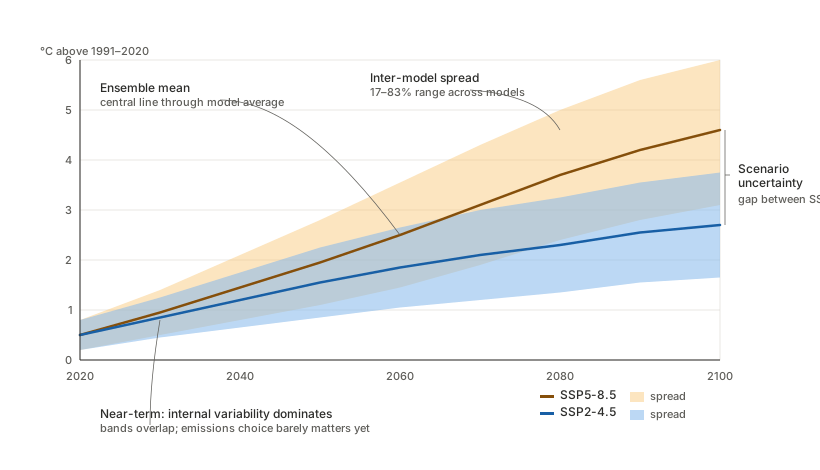
A rough rule: for near-term horizons (2030s), internal variability dominates the spread. For end-of-century horizons (2080s+), scenario uncertainty does. Model uncertainty is in the middle and matters most at the regional scale — which is exactly where you’re working.
How to read a projection chart
A typical chart shows two things layered on top of each other:
- An ensemble mean — a single thick line through the average of multiple models. This is your central estimate.
- A spread band — usually shaded — showing the inter-model range (typically ±1 standard deviation, or the 17–83% inter-model interval). This is the uncertainty.
If multiple emissions scenarios are shown, each one gets its own coloured mean-and-spread band. The bands almost always overlap in the near term and diverge later as scenario uncertainty grows.
If a chart shows only the mean and not the spread, half the story is missing — treat it with caution and look for the source’s underlying data. Honest charts always include the spread.
Where this fits in a climate rationale
A defensible climate rationale for a Green Climate Fund concept note, an Adaptation Fund proposal, or a national NAP submission usually has four parts:
- Observed climate context — the current baseline. Best continental source: WMO State of the Climate in Africa 2024 (African temperature anomaly +0.86 °C vs the 1991–2020 baseline; North Africa fastest-warming; 2024 saw Sahel floods and Kenya MAM floods).
- Observed change — recent trends in temperature, rainfall, extremes.
- Projected change — what this wiki section helps you cite defensibly.
- Adaptation logic — how the projected changes drive the intervention you’re proposing.
Projections sit in part (3), but always read alongside (1) and (2) — a projection that contradicts the observed trend (as for East African long rains; see East African Paradox) is a known-difficult case, not a free pass to use the model number.
What this wiki section can answer
| Question | Page |
|---|---|
| What’s actually inside a climate model? | Climate models 101 |
| Why do models disagree? | Why models disagree |
| What does “downscaled” mean? | Downscaling |
| What does “bias-corrected” mean? | Bias correction |
| Which datasets exist and what should I use? | Dataset landscape |
| Which models work best over my region? | Regional evaluation |
| What does the AAA Adaptation Atlas specifically use? | African CMIP6 Ensembling |
| Why is East African rainfall a special case? | East African Paradox |
| What’s coming next? | CMIP7 + CORDEX-Africa |
Further reading
- IPCC AR6 WGI Chapter 1 — Framing, context, methods — the canonical reference for what climate projections are and aren’t.
- IPCC AR6 Interactive Atlas — region-by-region projection viewer; explore SSP bands for any AR6 reference region.
- WMO State of the Climate in Africa 2024 — the most authoritative observational baseline for continental and regional change.
- Hawkins & Sutton 2009 — The potential to narrow uncertainty in regional climate projections — the original framing of the three uncertainty sources.
- Carbon Brief — How Shared Socioeconomic Pathways explore future climate change — non-specialist orientation to SSPs.
- Carbon Brief — CMIP6: the next generation of climate models explained — what changed from CMIP5 to CMIP6 and why it matters.